AI is changing content marketing in 2026 by automating the work that used to eat a marketer's week: drafting blog posts, editing video, generating graphics, researching keywords and personalizing content at scale.
It doesn't replace strategy or human judgment. It clears the grunt work, so teams ship more and spend their time on the ideas that set them apart.
AI is also changing where content gets read. More buyers now get their first answer from ChatGPT, Gemini, Perplexity or a Google AI Overview, so your content has to be useful to the person reading it and clear enough for an AI system to quote.
In this article we cover what AI content marketing is, what has changed in 2026, the tools teams are using, where AI content goes wrong, how to build a strategy around it, and how Core dna can help you reach your content marketing goals.
What is AI content marketing?
AI content marketing is the use of artificial intelligence across the content process: researching topics, drafting and editing copy, producing images and video, optimizing for search, personalizing what each visitor sees and measuring what works. The strategy, the point of view and the final call on what gets published stay with your team.
Where were you back in 2022 when ChatGPT stormed onto the scene? Were you in business, in tech, or even in a content creation role?
For those of us who were content marketers, ChatGPT took our industry by storm. It's hard now to look back and think how we made content without AI tools giving us a little push when we need it. But at the time, ChatGPT was, without a doubt, revolutionary.
Four years on, AI content is everywhere. You'll almost certainly have clicked on an AI-generated blog post, watched an AI-generated video or received an AI-generated email. In HubSpot's 2026 State of Marketing report, a survey of more than 1,500 marketers, about 80% said they use AI for content creation (42.5% extensively and 38% occasionally), and about 75% use it to create media like images and video.
Numbers like these count how many people use AI. They say much less about how much of the work runs through it. Among US workers who use AI, Gallup found in May 2026 that writing and editing (51%) and search or research (49%) were the top uses, while 16% used it for automation. We looked at what six major adoption surveys actually measure in AI adoption rates count heads instead of work.
So what does this mean for content marketing in 2026? Let's look at what has changed.
How is AI changing content marketing in 2026?
AI content creation
From simple blogging to video creation and photo editing, AI tools now show up in every step of content creation. Used well, they make a small team far more productive.
Generative AI assistants like ChatGPT, Claude, Gemini and Jasper answer prompts to analyze trending topics, search queries and audience behavior. They produce content ideas in seconds, and with the right prompts you can work with them to turn those ideas into full-length blog posts, social media graphics, white papers and even websites. This article has more than 35 SEO prompts to help you generate content.
Our top tip for AI SEO blog writing? Do your research first. Before you use your blog writing prompt, use a prompt to research the search results for the keyword you want to rank for.
Ask ChatGPT, or whichever AI tool you use with web access, to analyze the top 10 results and build your article outline from them. You can also use it to find the related keywords and the questions your article should answer.
If you generate the draft with AI as well, add proprietary information, your own data or first-hand experience, so readers get something they can't find in the other ten results.
Check out this video for more tips on how to speed up content and video creation with AI.
Personalization at scale
AI also shines beyond content generation. Some of the most innovative ways AI is being built into a content marketing strategy come from how it lets businesses personalize the way their content is presented to each user.
Let's take an example. Imagine a travel company offering unique trip options based on the country their visitor lives in. Or imagine a fashion company showcasing its products on models with your body type, so you can really picture how those clothes would look on you.
All these are ways AI is being used to personalize content experiences.
In our article on eCommerce trends, we saw how AI is transforming the way brands interact with their customers. If A/B testing was once the rule of optimization, generative AI has enabled hyper-personalization, which takes it to another level.
Brands can get granular when segmenting their database and let AI decide which option to show based on each customer's profile.
How is that different? With a classic A/B test, if option B won, option B was shown to everyone. That only gave us a general result. What if, for women aged 30 to 40, option A was actually more popular?
Before AI, getting this detailed took a lot of time. Today, generative AI tools can do the job for us and show the best option for each segment.
Get deeper into this by checking out Klaviyo AI. Integrating Klaviyo with your eCommerce platform gives you powerful tools to enhance personalization.
For businesses looking to experiment with this, tools like Dynamic Yield or HubSpot help you segment audiences and personalize content across all your touchpoints.
Recommendation engines are the version most customers already know. Netflix has said about 80% of what its members watch comes from recommendations. Our guide to recommendation engines covers how they work and what Google, YouTube, Amazon and Spotify are changing next.
Predictive analytics for better decisions
Got data? Then you can use AI in even more innovative ways. AI can analyze your historical data to predict how your content will perform. With dynamic scheduling, you can post new content at the moment it's most likely to be seen.
To do this, use tools like Google Analytics 4 to refine your publishing schedule and content formats for the best results.
More formats from the same source
Demand for content keeps rising faster than content teams grow. AI helps close that gap by turning one strong piece, such as a report, a webinar or a long-form guide, into the many assets a campaign needs: blog posts, social posts, email copy, short videos and sales one-pagers.
The research and the point of view still come from your team. AI handles the reformatting, so your best thinking reaches more channels without adding headcount.
What AI tools do content marketers use?
Generative AI now covers almost every content format. Video, audio, graphics, infographics and design are all things AI can take off your plate. Here are the tools worth knowing, by format.

AI writing and SEO tools
Writing blogs is all about improving SEO rankings, and that doesn't happen by accident. You need a reliable content calendar packed with keyword-optimized pieces that move the needle on your traffic.
In the past, writing SEO-optimized blogs was complicated. You'd need an expert writer to get the format, internal linking and keyword approach right. Now a few AI SEO tools cover most of that groundwork.
SurferSEO: A comprehensive suite of tools that can help you create content from scratch, analyze your competitors and identify opportunities for improvement.
Writesonic: Some say Writesonic is an even better writer than ChatGPT. We'll let you judge by testing the same prompt on both.
Neuron Writer: Like SurferSEO, Neuron Writer helps you keep track of the keywords in your article and write well-optimized content for search engines.
For example, you could write a blog with SurferSEO's AI credits that analyzes the search results and suggests keywords, FAQs, images and even alt text. You'd still edit it, fact-check it and add your own expertise, but the groundwork takes minutes.

AI video tools
One great SEO trick is to include video content on your pages. But creating video is time consuming, with filming, costly recording studio invoices and long script writing processes.
The good news is that these tools can help you create video content without a camera crew.
HeyGen: If you have a camera-shy team and no budget for a professional video crew, HeyGen is your tool. With realistic AI avatars, it can create human-like video in more than 175 languages.
Pictory: If you have an idea but aren't sure how to translate it to video, try Pictory. It creates videos from text, slides or even images, so you can type your idea and let it do the rest.
Veed: A video editing tool on autopilot. It's an all-in-one tool that's popular for creating videos with generative AI, with AI voiceover, subtitles, avatars and much more.
Revid.ai: Create social shorts in minutes, from ideation to publishing. It's a suite of 20+ AI video tools you can use with a few clicks.
Now there's no need to overcome your stage fright. You can get an AI avatar to present that podcast for you.
You can also use AI tools to streamline editing, add closed captions for accessibility, remove background noise and even touch up your makeup.
Not sure how this would work?
Imagine an eCommerce brand taking its existing product images and turning them into conversion-oriented videos with AI.
Or imagine a podcaster turning a photo of themselves into an AI video avatar that presents an entire online course or webinar, without the podcaster even being there. It's all possible in 2026.

AI tools for graphic design
Bored of the same old stock photos? So are we. More importantly, so are your customers.
With AI design tools, you can create eye-catching graphics in minutes. Imagine turning a blog post into an infographic for your audience, or creating photos of anything you can dream of from a simple prompt.
This is the power of AI design tools like:
Canva's AI: Canva has added strong AI features to its platform. From magic eraser to text-to-image creation, anyone can use it to upgrade their visuals.
ChatGPT images: OpenAI's image generation inside ChatGPT, which replaced DALL-E 3. It's still not perfect, but it's useful in creative briefs to illustrate what you're trying to achieve.
Adobe Firefly: The suite most creatives already use now has AI built into its tools.
Midjourney: If you haven't seen a Midjourney image yet, it's impressive. Midjourney takes more skill to use well, but the quality is brilliant.
Tools like these help marketers create appealing graphics without booking an expensive graphic designer for every asset, so your content catches the reader's eye without breaking the bank or dragging out the timeline.
How does AI improve SEO for content marketing?
We've seen graphic design, podcasts and endless blogs all generated with AI. But when it comes to AI-powered marketing, improving your SEO is one of the most valuable uses.
For brands aiming to improve visibility and get more return from their content, AI provides an edge that's hard to ignore. For a deeper walkthrough, see our practical guide to content optimization with AI.
Smarter keyword research
With generative AI built into tools like SEMrush and Ahrefs, keyword research has changed.
Instead of hours spent manually analyzing search terms (who else remembers those long hours staring at Google Trends?), these tools uncover trends and surface long-tail keyword opportunities that might otherwise be missed. And you can do it in seconds.
Refining content
As any content marketer worth their salt will tell you, content that performs in search takes more than the right keywords, whatever tool you used to find them.
AI platforms like SurferSEO and MarketMuse help marketers with the finer points of optimization, from improving headings and meta descriptions to strengthening internal link structures.
Competitor analysis
Understanding what competitors are doing has always been essential, and AI takes it a step further. Platforms like SimilarWeb and Crayon give you a deep view of competitor strategies and highlight the opportunities they've missed.
For instance, if a competitor hasn't covered a specific topic cluster, that's an opening to capture a new audience. This level of insight lets marketers approach gaps strategically and create content that fills them.
How does AI search change content marketing?
A few years ago, the next big shift in search was supposed to be voice. It pushed content toward a more conversational style, but most people kept typing their searches and the results page looked much the same.
AI search is a bigger change. Google AI Overviews, AI Mode, ChatGPT, Gemini and Perplexity now answer many questions directly and cite a handful of sources. The buyer may never see a list of links. That gives content marketers a second goal: your content still has to rank, and it also has to be the source an AI system chooses to quote, describing your brand accurately.
We tested how this plays out ahead of Black Friday. In September we asked ChatGPT the price of one product at 51 of Australia's most-loved retailers. It got 43 right, and every wrong price came from a page other than the product page: a sale page, a collection page or a price comparison site (read the September findings). In October we asked where 20 popular Black Friday products were cheapest. When ChatGPT recommended a top retailer, the price was wrong 15 times out of 24, and for 14 of the 20 products, asking again minutes later returned a different store or price (see who it recommended).
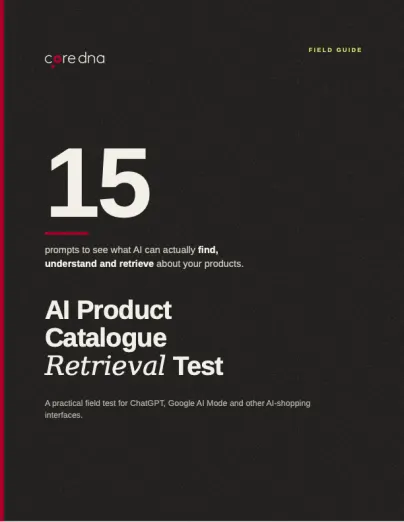
AI answers behave like earned media. You can't write the answer, but you can shape the sources it draws on and measure what it says about you. Our 15 copy-and-paste prompts are a quick way to start measuring.
The work overlaps heavily with good SEO. To give your content the best chance of being cited:
- Answer the question in the first lines of each section, so an AI system can lift the answer cleanly.
- Include facts it can check, such as prices, specs, dates, your own data and named sources.
- Make your pages agree. If your product pages, blog and help center give different answers, AI tools pick one, and it may be the wrong one.
- Get mentioned beyond your own site, in reviews, industry press, forums and partner pages.
- Keep content current. An outdated page is a page an AI tool can quote wrongly.
You can also publish an llms.txt file, a plain-text index of the pages you most want AI systems to read. Google Search doesn't use it today, so treat it as optional.
Our AEO and GEO optimization guide covers each step in detail, including how to track where AI answers cite you.
There is now a paid side too. OpenAI started testing ads in ChatGPT in February 2026, and by August they were live in 40 markets, with retailers' product feeds serving as the ad unit. We covered what that means in ChatGPT ads and eCommerce.
Should AI answers be their own channel in your 2027 marketing plan, next to search and social?
This is our take: yes. Give AI answers their own line in the plan and their own measure, such as how often AI tools cite or mention you for the prompts your buyers use. Keep ownership with your content and SEO team, since the same content does the work in both places. Our AI visibility playbook covers how to set it up and measure it.
What are the risks of AI content marketing?
AI makes content faster and cheaper to produce. The risks come from the same place.
Everyone's content starts to sound the same
If you're using AI tools to generate ideas, chances are your competitors are too. Without a human adding a point of view, your content gets lost in the blur of similar content online. Use AI for the groundwork and keep the angle, the examples and the opinions your own.
AI gets facts wrong with confidence
Generative AI can invent statistics, quotes and product details that sound right. Google's guidance on generative AI content says it is "critical to manually factcheck and review all AI-generated content for accuracy and trustworthiness before publishing." That includes titles, meta descriptions and image alt text.
Your brand voice drifts
Ten people prompting ten tools will get ten versions of your brand. Give your AI tools the same brand guidelines, tone rules and approved product facts every time, and keep a human approval step before anything goes live. The same applies to how AI search describes you: if your own site isn't clear and consistent about what you do, AI tools fill the gaps from other sources.
Publishing at volume without adding value
Google doesn't penalize content for being written with AI. Its spam policies target scaled content abuse: many pages produced to manipulate rankings without helping users, however they were made. Our SEO guru puts every piece through one test: "If a Google engineer was looking over your shoulder, would you still post it?"
Will AI replace content marketers?
Every new creative tool has raised this question. Desktop publishing was going to replace designers. Stock photography was going to replace photographers. Both changed the job, and both made good people more productive. Do you think AI will be different?
This is our take: AI will take over a lot of content tasks, and teams that use it well will outpace teams that don't. It won't replace the people who decide what the brand stands for, understand the customer and judge whether a piece is worth publishing. Those jobs get more important as the amount of AI content grows.
How do you build an AI content marketing strategy?
Start with the work your team already does and add AI where it saves the most time or adds the most reach.
- Map your content workflow. List every step from idea to published piece to reporting, and note where the time goes.
- Pick two or three use cases to start. Research and outlining, repurposing long-form content, and refreshing posts that already rank are good first candidates because they're easy to measure.
- Write down your rules. Brand voice, approved facts, what always needs a human review, and what you disclose about AI use. For any AI tool that can touch your site, also settle what it can read, what it can change, who signs off and what gets logged.
- Connect AI to the systems where your content lives. Copying and pasting between a chat window and your CMS doesn't scale. Look for tools that can work inside your CMS and stage changes for approval.
- Measure and adjust. Track time to publish, output per person, rankings, AI citations and conversions, and drop the use cases that don't pay off.
How we used AI to refresh this article
This article is a working example. We pulled 28 days of Google Search Console data for this page, then had an AI agent connected to our CMS through Core dna MCP compare the queries people searched with what the article covered. It found the gaps (no clear definition, nothing on AI search, an examples section with no examples), reordered the sections around the questions people were asking, and saved the changes as a draft revision. A person on our team reviewed and edited the draft before it went live.
How can your CMS help with AI content marketing?
Creating compelling content is only one part of a successful content marketing strategy. Delivering the right content to the right people at the right time is what determines success. This is where a content management system (CMS) that is adaptable, intelligent and scalable makes the difference.
1. AI that works inside your CMS
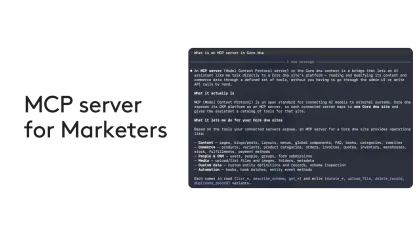
Most teams still use AI in a separate chat window and paste the results into their CMS. The next step is AI that works in the CMS directly. Core dna has a native MCP (Model Context Protocol) server, so assistants like Claude and ChatGPT can create and update pages, blog posts, products and menus on your site from a plain-language request. Each change is saved as a new revision with the previous version kept, so your team can review it before it goes live and undo it if needed. Since MCP 2.0, an assistant can change one paragraph and leave the rest of the page exactly as it was.
Core dna is also built on a composable architecture, so you can connect the AI writing, SEO and personalization tools your team already uses. See 10 multi-property workflows teams run on Core dna MCP for examples.
2. Personalized content from one source
Personalization is the future of brands in every industry. With AI, businesses of all sizes can create personalized experiences across all channels.
Your CMS should help you deliver those experiences at scale, tailoring content to different customer segments based on their preferences, behaviors and demographics. By analyzing customer data, it can adjust content for individual users so every touchpoint feels relevant, whether that's on your website, in email campaigns or in mobile apps.
3. Analytics that predict content performance
Your CMS should come with analytics that help you predict how your content will perform. With predictive analytics connected to your CMS, you can use historical data to refine your content strategy and reach the right audience at the right time.
Want to know the best times to post? Or which topics are trending in your niche? With your CMS, these insights can be automated, making your marketing more effective and data-driven.
This is especially useful when timing and context are everything. Your CMS can help schedule posts and content releases for when they're most likely to engage your audience.
4. Omnichannel content delivery
Customers expect a similar brand experience across all devices and locations. Your content management system should offer headless capabilities so you can deploy content across multiple touchpoints with ease.
This also means one central content hub can feed multiple microsites, landing pages and marketplaces. It keeps your brand consistent and your content wherever your audience is. With AI connected to your CMS, it can even help adapt content for each channel.
5. Workflows, approvals and version control
As your content team grows, so does the need for collaboration. Enterprise content management systems should make it easy for teams to work together, whether they're in one office or spread across the globe.
From planning to creation to publishing, your CMS should simplify workflows, making it easier to coordinate, track progress and keep everyone aligned on strategy. This matters more once AI is in the mix, because more drafts need a clear path to approval. For groups running many sites, approval has to work per property, since one instruction can reach dozens of sites at once.
By automating repetitive tasks like scheduling posts or routing approvals, your team can focus on strategic work. Your CMS should also offer easy version control and feedback loops, so content meets your quality standards before it's published.
6. Scalability for future growth
Whatever your industry, one of the most important factors when choosing a CMS in 2026 is its ability to scale with your business. As your content marketing grows, your CMS should handle an increasing volume of content without sacrificing performance.
As you expand into new markets or add new content types, a scalable CMS keeps up with your needs and lets your content marketing strategy keep growing.
What content marketing trends should you plan for in 2026?
One way to stay ahead is to spot trends early, and AI is good at that. It can identify topics and keywords likely to gain traction, recognizing patterns people tend to miss.
A content marketer might discover, for example, that interest in "hyper-personalized AI marketing" is on the rise and get ahead by creating content around it.
Pulling together what this article covers, these are the trends we would plan for:
- AI answers as a channel. More discovery starts in ChatGPT, Gemini and AI Overviews, so citations and brand accuracy join rankings as goals.
- More output from the same team. Turning one strong piece into many formats becomes standard practice.
- Original data and first-hand experience. With generic content cheap to produce, your own research, customer stories and opinions are what earn links, citations and trust.
- Video without a production crew. AI avatars, text-to-video and automated editing make regular video realistic for small teams.
- AI agents working in the CMS. Teams move from pasting AI output into the CMS to letting agents draft, update and refresh content there, with a person approving each change.
AI content marketing FAQs
Does Google penalize AI-generated content?
No, not for being AI-generated. Google ranks content on whether it's helpful and reliable. Its spam policies apply to pages mass-produced to manipulate rankings without adding value, however they were made. Fact-check AI drafts and add your own expertise before publishing.
How do you keep AI-generated content on brand?
Give every AI tool the same inputs: brand voice guidelines, words to use and avoid, approved product facts and a few examples of your best content. Keep a human review step before publishing, and store approved facts in one place so every page says the same thing.
Can AI predict which content will perform best?
It can make a good estimate. AI tools can analyze your historical traffic, engagement and conversion data, show which topics and formats work for each audience, and flag rising search interest. Treat the predictions as a starting point and test them against real results.
What is the best AI tool for content marketing?
No single tool covers everything. Most teams combine a general assistant like ChatGPT, Claude or Gemini for research and drafting, an SEO tool like SurferSEO for optimization, and specialist tools for video and design. The bigger gains come from connecting those tools to your CMS, so content moves from draft to published without copy and paste.
How do you measure AI content marketing?
Measure the efficiency gains and the results. For efficiency, track time from brief to publish and output per person. For results, track rankings and organic traffic, how often AI answers cite or mention your brand, and engagement and conversions from AI-assisted content compared with the rest.
Summarize with